Market Definition, Recent Developments & Industry Trends
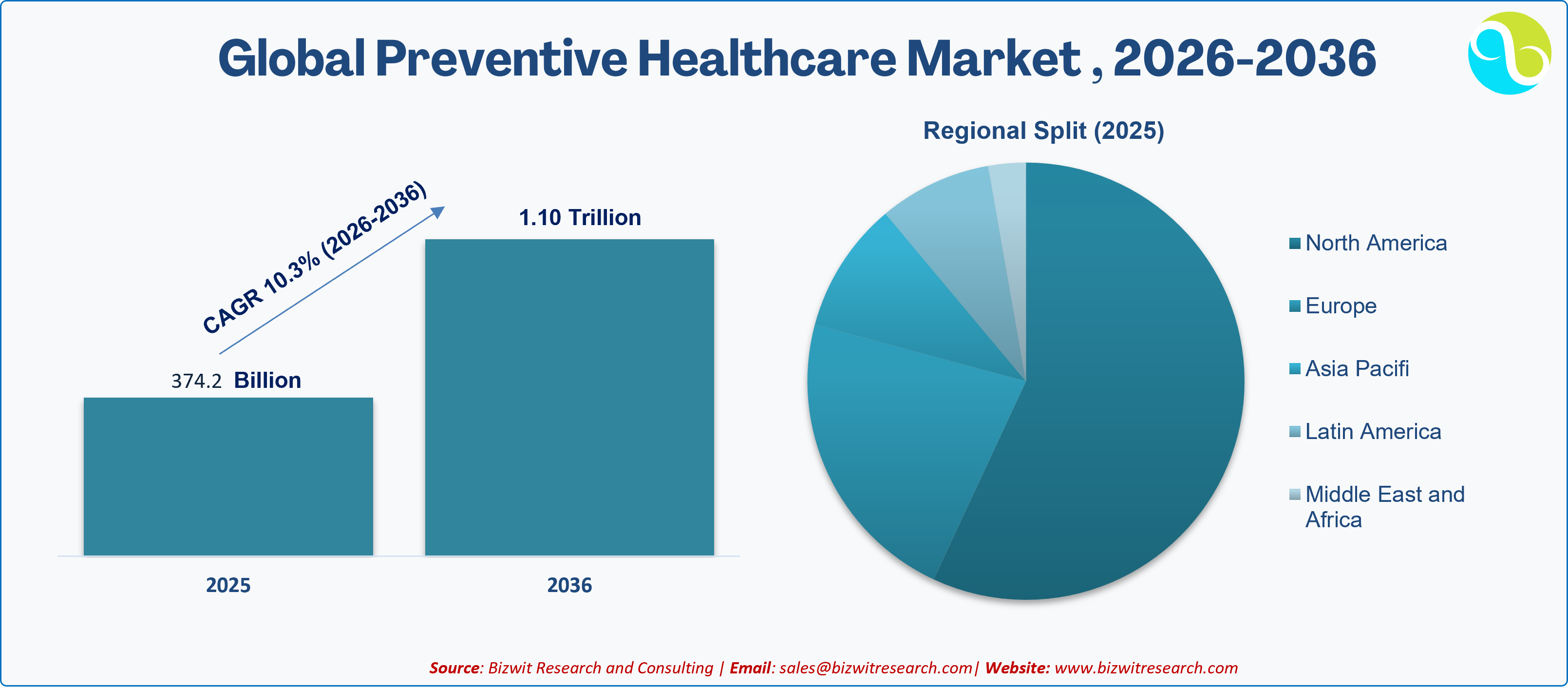
The global preventive healthcare market is estimated at USD 374.5 billion in 2025 and is projected to reach approximately USD 1.10 trillion by 2036, reflecting a CAGR of around 10.3% from 2026 to 2036. The market
encompasses a wide array of solutions aimed at early disease detection, risk
mitigation, and long-term health management. Unlike traditional reactive
healthcare models, preventive healthcare focuses on identifying potential
health risks before they evolve into critical conditions. This market includes
technologies and services such as screening and diagnostic tools, chronic
disease monitoring devices, vaccines, and advanced systems designed to reduce
medical errors and enhance clinical accuracy. Key stakeholders include
healthcare providers, medical device manufacturers, pharmaceutical companies,
digital health platforms, and public health organisations.
The market has witnessed a paradigm shift in recent years, driven by
increasing awareness of preventive care, rising healthcare costs, and the
growing burden of chronic diseases. Governments and healthcare systems
worldwide are prioritizing early intervention strategies to reduce long-term
treatment costs and improve patient outcomes. The integration of digital health
technologies, including remote monitoring, wearable devices, and AI-driven
diagnostics, is further accelerating this transition.
A notable trend is the convergence of personalized medicine with preventive
healthcare, enabling tailored interventions based on genetic, lifestyle, and
environmental data. Additionally, vaccination programs are expanding beyond
traditional infectious diseases to include areas such as oncology and
immunotherapy. Healthcare systems are also adopting advanced technologies such
as electronic prescribing and clinical decision support systems to minimize
errors and enhance patient safety. Looking ahead, preventive healthcare is
expected to become a central pillar of global healthcare systems, supported by
technological innovation and policy alignment.
Market Determinants
Rising Burden of Chronic Diseases
The increasing prevalence of chronic conditions such as diabetes,
cardiovascular diseases, and respiratory disorders is a major driver of the
preventive healthcare market. Healthcare systems are shifting focus toward
early diagnosis and continuous monitoring to reduce hospitalization rates and
long-term treatment costs. Preventive technologies enable timely intervention,
improving patient outcomes while reducing economic strain on healthcare
infrastructure.
Shift Toward Value-Based Healthcare Models
The transition from fee-for-service to value-based care is fundamentally
reshaping healthcare delivery. Preventive healthcare solutions align closely
with this model by emphasizing outcomes, cost efficiency, and patient-centric
care. Payers and providers are increasingly incentivized to invest in
technologies that reduce disease incidence and improve long-term health
metrics.
Technological Advancements in Diagnostics and Monitoring
Rapid innovation in diagnostic tools, wearable devices, and remote
monitoring technologies is enhancing the effectiveness of preventive
healthcare. AI-driven screening tools, real-time health tracking, and
predictive analytics are enabling early detection of diseases and personalized
care pathways. These advancements are making preventive care more accessible
and scalable.
Expansion of Vaccination Programs
Vaccines continue to play a critical role in preventive healthcare, with
expanding applications beyond infectious diseases. Advances in biotechnology
are enabling the development of vaccines for cancer and other complex
conditions. Increasing immunization coverage and government-led vaccination
initiatives are further driving market growth.
Data Privacy and Integration Challenges
Despite strong growth potential, challenges related to data privacy,
interoperability, and integration of diverse healthcare systems persist. The
effective implementation of preventive healthcare solutions requires seamless
data exchange across platforms, which remains a complex and resource-intensive
process.
Limited Awareness and Accessibility in Emerging Regions
In many developing regions, lack of awareness, inadequate healthcare
infrastructure, and limited access to preventive services hinder market growth.
Addressing these gaps requires coordinated efforts from governments, private
sector players, and international organizations.
Opportunity Mapping Based on Market Trends
Personalized Preventive Healthcare
The integration of genomics, AI, and digital health is creating
opportunities for personalized preventive care. Tailored screening programs and
targeted interventions based on individual risk profiles are expected to drive
higher adoption and better outcomes.
Digital Health and Remote Monitoring Expansion
The proliferation of wearable devices and telehealth platforms is enabling
continuous health monitoring and early intervention. This trend is particularly
significant for chronic disease management, where real-time data can
significantly improve treatment adherence and outcomes.
Preventive Care in Emerging Markets
Emerging economies present significant growth opportunities due to
increasing healthcare investments, rising awareness, and expanding digital
infrastructure. Government initiatives aimed at improving public health are
expected to accelerate adoption.
Integration of Safety and Error-Reduction Technologies
Technologies designed to reduce medical errors, such as clinical decision
support systems and electronic prescribing, are gaining traction as healthcare
systems prioritize patient safety and operational efficiency.
Report Attributes | Details |
Market Size in 2025 | USD 374.5 Billion |
Market Size by 2036 | USD 1.0 trillion |
CAGR | CAGR of 10.3 % From 2026 to 2035 |
Base Year | 2025 |
Forecast Period | 2026-2035 |
Historical Data | 2022-2024 |
Key Segments | -
Early Detection & Screening Technologies (Automated screening, Personalized medicine, Other advanced screening technologies)
-
Chronic Disease Management Technologies (Blood pressure monitors, Asthma monitors, Cardiovascular monitors, Glucose monitors)
- Vaccines (Infectious diseases, Cancer vaccine, Autism vaccine, Allergy vaccine, Other new vaccines)
-
Advanced Technologies to Reduce Errors (Electronic prescribing, Clinical decision support system, Smart infusion pumps, Computerized provider order entry system, Smart packaging)
|
Regional Analysis/Coverage | North America (US, Canada), Europe (Germany, UK, France, Italy, Spain, Rest of Europe), Asia Pacific (China, India, Japan, South Korea, Australia, ASEAN Countries, Rest of Asia Pacific), Middle East & Africa (UAE, Saudi Arabia, Qatar, South Africa, Rest of Middle East & Africa), Latin America (Brazil, Argentina, Mexico, Colombia, Rest of Latin America). |
Company Profiles |
Myriad Genetics, Inc.; Quest Diagnostics Incorporated; Medtronic; Abbott; Merck & Co., Inc.; GSK plc; Omnicell; MCKESSON CORPORATION
|
Value-Creating Segments and Growth Pockets
Early Detection & Screening Technologies currently dominate the
preventive healthcare market, driven by their critical role in identifying
diseases at an early stage and enabling timely intervention. These technologies
are widely adopted across healthcare systems due to their direct impact on
reducing disease burden and improving patient outcomes.
However, Chronic Disease Management Technologies are expected to witness
accelerated growth, supported by the increasing prevalence of long-term health
conditions and the rising adoption of remote monitoring solutions. Devices such
as glucose monitors and cardiovascular tracking systems are becoming essential
tools in managing chronic diseases effectively.
Vaccines continue to represent a stable and high-impact segment, with
expanding applications in emerging therapeutic areas such as oncology.
Meanwhile, Advanced Technologies to Reduce Errors are gaining prominence as
healthcare systems focus on improving patient safety, operational efficiency,
and clinical accuracy. These technologies are expected to emerge as key growth
pockets, particularly in developed healthcare markets.
Regional Market Assessment
North America
North America dominates the preventive healthcare technologies and services
market, accounting for approximately 35% of global revenue. This leadership is
driven by advanced healthcare infrastructure, high healthcare expenditure, and
early adoption of innovative medical technologies. The region has a strong
focus on preventive care, supported by favourable reimbursement policies and
government initiatives promoting early diagnosis and disease prevention. The
widespread adoption of digital health platforms, wearable devices, and
AI-driven diagnostics is further strengthening market growth. Additionally, the
presence of leading pharmaceutical and medical device companies fosters
continuous innovation. Regulatory emphasis on patient safety and quality care
continues to accelerate the adoption of preventive healthcare solutions.
Europe
Europe holds an estimated 25% share of the global market, supported by
robust public healthcare systems and strong regulatory frameworks. The region
places significant emphasis on preventive care as a means to manage rising
healthcare costs and aging populations. Government-led screening programs and
vaccination initiatives play a critical role in driving market adoption.
Additionally, stringent data protection regulations influence the deployment of
digital health solutions, encouraging secure and compliant systems. The
increasing focus on personalised medicine and integrated healthcare delivery
models is further shaping market dynamics. Europe’s commitment to
sustainability and healthcare innovation continues to support steady market
growth.
Asia Pacific
Asia Pacific accounts for approximately 20% of the global preventive
healthcare market and is expected to be the fastest-growing region, with an
estimated CAGR of 14% during the forecast period. Rapid urbanisation,
increasing healthcare awareness, and rising prevalence of chronic diseases are
key growth drivers. Governments across countries such as China and India are
investing heavily in healthcare infrastructure and preventive care initiatives.
The growing adoption of digital health technologies, including telemedicine and
mobile health applications, is enhancing accessibility and affordability.
Additionally, the region’s large population base and expanding middle class
present significant opportunities for market expansion.
LAMEA
The LAMEA region represents approximately 10–15% of the global market,
reflecting its emerging yet promising growth potential. In the Middle East,
government-driven healthcare reforms and investments in advanced medical
infrastructure are accelerating the adoption of preventive healthcare
technologies. Latin America is witnessing increasing demand for preventive
services as healthcare systems focus on improving efficiency and reducing
long-term costs. Africa, while still at an early stage, is gradually adopting
preventive healthcare solutions supported by international health programs and
improving digital connectivity. However, challenges such as limited
infrastructure and economic constraints may impact the pace of adoption.
Recent Developments
- February 2024: A leading healthcare
technology company launched an AI-powered early screening platform, enhancing
diagnostic accuracy and enabling faster disease detection. This reflects the
growing role of AI in preventive healthcare.
- December 2023: A global pharmaceutical
firm expanded its vaccine portfolio to include next-generation immunotherapies,
highlighting the shift toward advanced preventive treatments.
- October 2023: A major healthcare provider
implemented a clinical decision support system across its network, improving
patient safety and reducing medical errors, underscoring the importance of
digital tools in healthcare delivery.
Critical Business Questions Addressed
What is the current and projected size of the
preventive healthcare market?
The report outlines market valuation and long-term growth trajectory, enabling
stakeholders to assess investment potential.
What are the primary drivers accelerating
preventive healthcare adoption?
It identifies key factors such as chronic disease burden, technological
advancements, and policy support.
Which segments offer the most significant growth
opportunities?
The analysis highlights high-growth areas including chronic disease management
and digital health-enabled screening.
How are regional dynamics shaping market expansion?
The report provides insights into regional growth patterns and emerging
investment hotspots.
What strategic moves are shaping the competitive
landscape?
It examines innovation, partnerships, and expansion strategies adopted by key
market players.
Beyond the Forecast
Preventive healthcare is transitioning from a supplementary approach to a
foundational pillar of global healthcare systems, driven by the need for cost
efficiency and improved patient outcomes. This structural shift is redefining
how healthcare value is created and delivered.
As digital technologies and personalized medicine continue to evolve,
preventive healthcare will become increasingly proactive, predictive, and
patient-centric. The integration of data-driven insights into clinical
workflows will further enhance the effectiveness of early intervention
strategies.
In the long term, the market will be shaped by the convergence of
technology, policy, and patient engagement, creating a more resilient and
sustainable healthcare ecosystem focused on prevention rather than cure.