Global AI-based Predictive Maintenance Market Size & Industry Overview
The global AI-based predictive maintenance market is estimated at USD
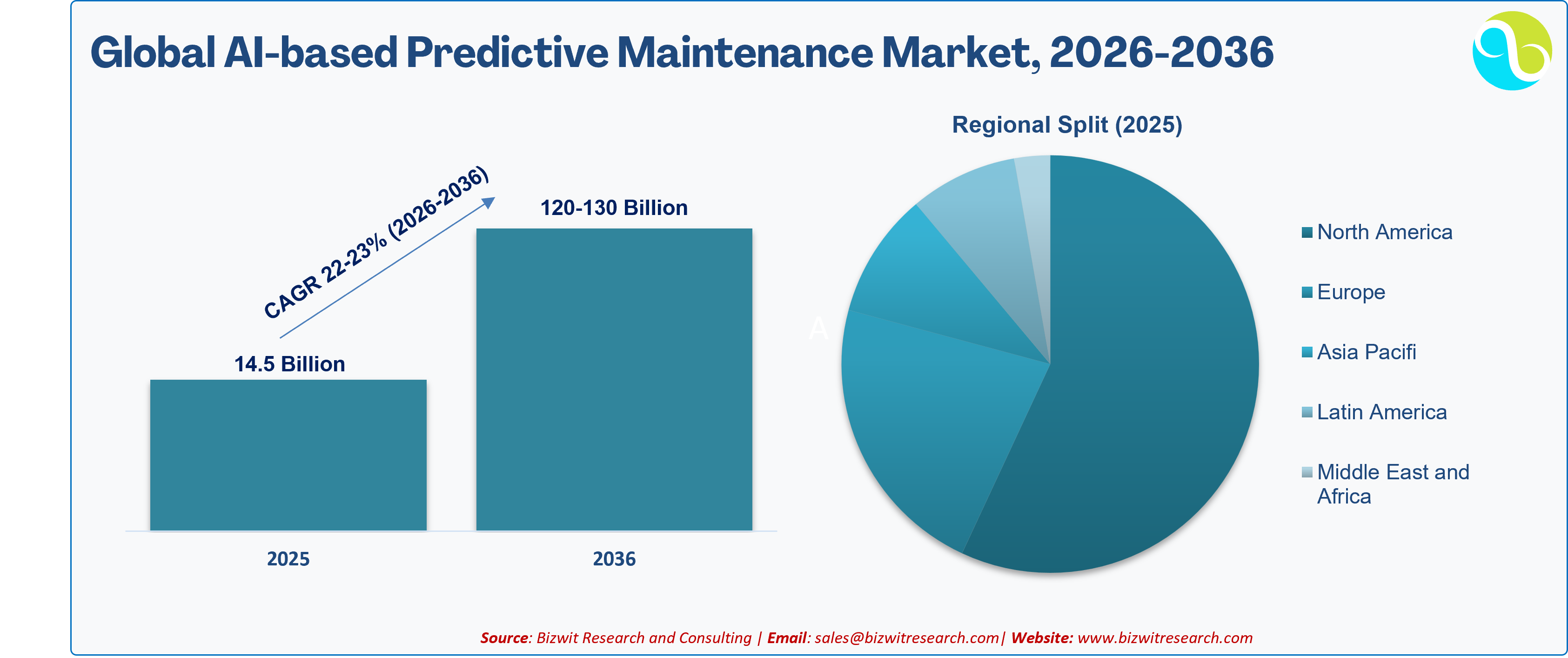
14.5
billion in 2025 and, under a moderated growth scenario, is projected to reach approximately USD 120–130 billion by 2036, reflecting a CAGR of around 22–23% from 2026 to 2036. AI-based predictive maintenance means using smart technology and data to predict when equipment might fail, helping companies reduce unexpected breakdowns, make their assets last longer, and improve maintenance planning. As industries move more towards Industry 4.0 and smart factories, predictive maintenance platforms are becoming essential tools that turn basic operational data into useful insights, helping businesses improve their reliability and save money.
Key Market Drivers Accelerating Adoption of AI-based Predictive Maintenanc
The accelerating pace of industrial automation, coupled with rising pressure to reduce operational expenditure, has significantly stepped up the demand for AI-powered predictive maintenance solutions. Manufacturing plants, energy utilities, transportation networks, and heavy industries are being compelled to move away from reactive and preventive maintenance models and lean into predictive strategies that proactively flag anomalies and degradation patterns. At the same time, the proliferation of IoT sensors, edge computing, and cloud-based analytics has widened the funnel for real-time condition monitoring. While high initial deployment costs and data integration complexities may slow adoption in certain regions, continuous advancements in AI algorithms and falling sensor prices are steadily ironing out these constraints, setting the stage for sustained long-term growth.
By Enterprises Type (Large Enterprises, SEMs)
By Application (Condition Monitoring, Predictive Analytics, Remote Monitoring, Asset Tracking, Maintenance Scheduling)
Vibration Monitoring Leading the Technology Segment
Among the various segments, vibration monitoring is expected to dominate the Global AI-based Predictive Maintenance Market during the forecast period. Vibration-based techniques are widely recognized for their effectiveness in detecting early-stage mechanical faults in rotating machinery, making them indispensable across manufacturing, automotive, and energy sectors. When augmented with AI models that continuously learn from historical and real-time data, vibration monitoring systems can forecast failures with remarkable accuracy. This capability has positioned the segment as a preferred choice for large-scale industrial operators seeking to scale predictive maintenance initiatives across diverse asset portfolios.
Solution Platforms Driving the Largest Revenue Share
From a revenue contribution perspective, the solution segment currently commands the largest share of the market. AI-driven predictive maintenance solutions are increasingly being adopted as comprehensive platforms that bundle data ingestion, analytics, visualization, and decision support into a single ecosystem. Organizations favor these solutions as they offer long-term value through continuous performance optimization rather than one-off services. Although service offerings—such as consulting, system integration, and managed services—are gaining traction, particularly among first-time adopters, core solution platforms continue to anchor revenue generation due to recurring licensing and subscription-based models.
Regional Market Trends and Growth Outlook
The market exhibits strong regional dynamics, with North America holding a leading position owing to early adoption of AI technologies, a well-established industrial base, and aggressive investments in digital transformation. Europe follows closely, supported by stringent efficiency standards, strong manufacturing heritage, and government-backed Industry 4.0 initiatives. Asia Pacific is projected to be the fastest-growing region over the forecast period, fueled by rapid industrialization, expanding manufacturing capacity, and growing awareness of cost-efficient asset management in countries such as China, Japan, and India. Meanwhile, Latin America and the Middle East & Africa are gradually catching up as infrastructure modernization and smart industrial investments gather momentum.
Report Attributes | Details |
Market Size in 2025 | USD 14.5 Billion |
Market Size by 2036 | USD 120-130 Billion |
CAGR | CAGR of 22-23% From 2026 to 2035 |
Base Year | 2025 |
Forecast Period | 2026-2035 |
Historical Data | 2022-2024 |
Key Segments | -
By Component (Solution, Service)
-
By Monitoring Technique (Torque Monitoring, Vibration Monitoring, Oil Analysis, Thermography, Corrosion Monitoring, Others)
- By Deployment (On-Premises, Cloud-based)
-
By Enterprises Type (Large Enterprises, SEMs)
By Application (Condition Monitoring, Predictive Analytics, Remote Monitoring, Asset Tracking, Maintenance Scheduling)
|
Regional Analysis/Coverage | North America (US, Canada), Europe (Germany, UK, France, Italy, Spain, Rest of Europe), Asia Pacific (China, India, Japan, South Korea, Australia, ASEAN Countries, Rest of Asia Pacific), Middle East & Africa (UAE, Saudi Arabia, Qatar, South Africa, Rest of Middle East & Africa), Latin America (Brazil, Argentina, Mexico, Colombia, Rest of Latin America). |
Company Profiles | Siemens AG, IBM Corporation, General Electric Company, Schneider Electric SE, Honeywell International Inc., ABB Ltd., Microsoft Corporation, SAP SE, Oracle Corporation, Bosch Rexroth AG, Emerson Electric Co., Hitachi Ltd., Rockwell Automation, Inc., Cisco Systems, Inc., NVIDIA Corporation
|
The objective of the study is to define the market size of different segments and countries in recent years and to forecast their values for the coming years. The report is designed to weave together both qualitative insights and quantitative analysis to deliver a comprehensive understanding of the industry landscape across the regions under consideration. It further sheds light on critical growth drivers, structural challenges, and emerging opportunities within micro-markets, while also mapping out the competitive environment and strategic positioning of leading players.
Key Takeaways
- Market estimates and forecasts spanning 2025 to 2035.
- Annualized revenue analysis at regional and segment levels.
- In-depth geographical insights with country-level coverage.
- Comprehensive competitive landscape and profiling of major players.
- Strategic evaluation of business approaches and future growth pathways.
- Balanced demand-side and supply-side assessment of the market.