test1
From Edge AI to Autonomous Systems: The Semiconductor Revolution Driving Intelligent Electronics
By Amol Meshram
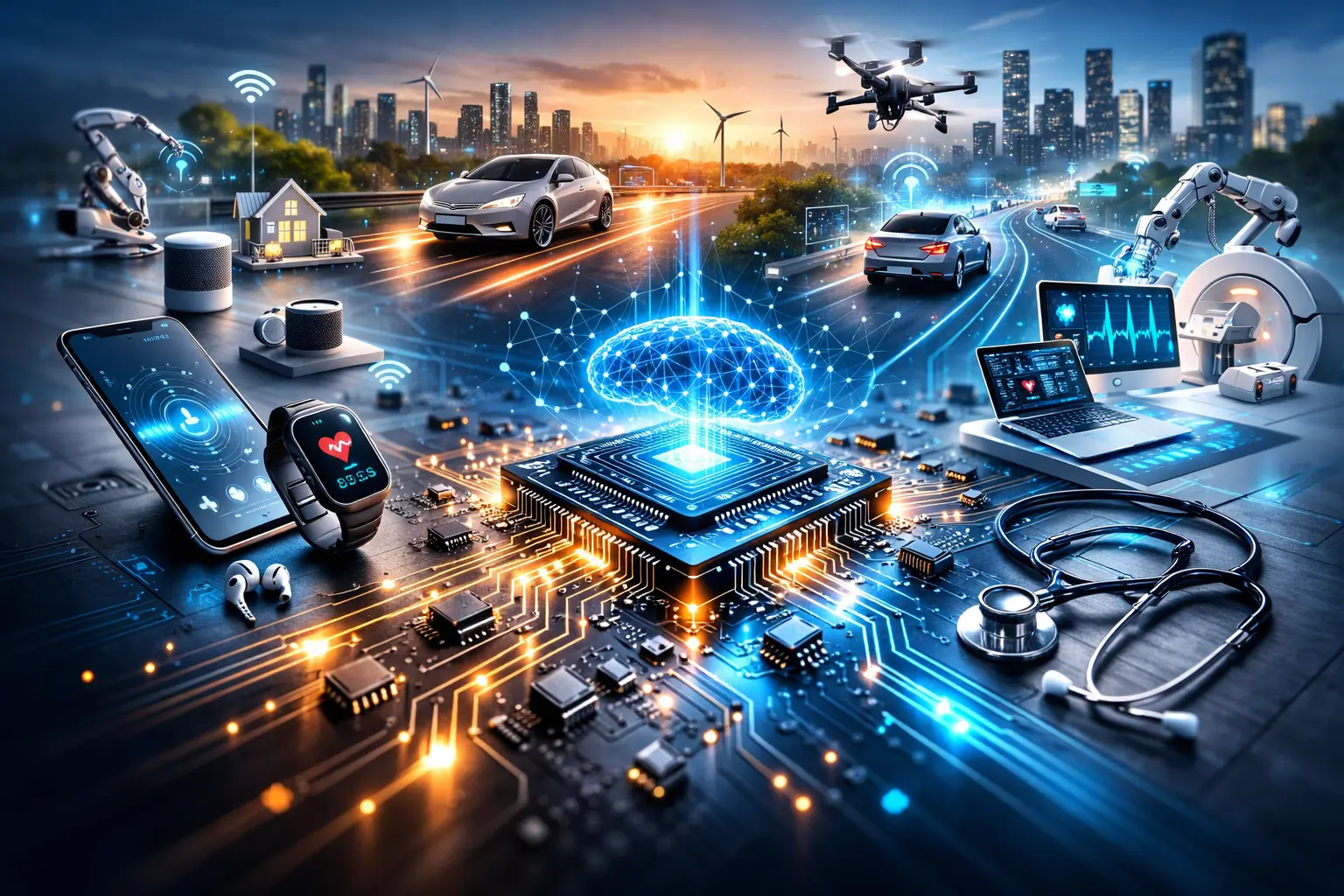
The global electronics industry is entering a new phase of accelerated intelligence. From smartphones and connected homes to electric vehicles and advanced healthcare devices, modern electronics are no longer defined solely by speed or miniaturisation. They are increasingly characterised by embedded intelligence, real-time responsiveness, and energy optimisation.
At the centre of this transformation are smart semiconductor and AI chips, the computational backbone enabling devices to process data faster, learn user behaviour, and make autonomous decisions. These advanced processors are not merely enhancing performance metrics; they are redefining how devices interact with users, manage energy consumption, and deliver contextual experiences.
In 2026, the role of AI-enabled semiconductors extends beyond incremental innovation. Growing demand for intelligent consumer electronics, the expansion of IoT ecosystems, rapid electrification in mobility, wider adoption of AI in healthcare, and the proliferation of wearable technologies are collectively accelerating the need for more powerful, efficient, and specialised chip architectures.
As expectations shift toward seamless automation, personalisation, on-device data processing, and improved battery efficiency, semiconductor innovation has become a strategic enabler of next-generation electronics. This article examines how smart semiconductor and AI chip advancements are shaping the future of intelligent devices and redefining the electronics landscape.
Key Ways Smart Chips Are Transforming Electronics
1. Smarter Smartphones & Wearables
Over 90% of premium smartphones now integrate dedicated AI engines (NPUs) to power features like computational photography, voice recognition, predictive text, and real-time translation. AI-enabled cameras process billions of operations per image, while on-device inference reduces latency by 30-50% compared to cloud processing.
The wearable market is also expanding rapidly, projected to exceed 500+ million annual shipments in the coming years. Most advanced devices embed AI chipsets for continuous heart-rate monitoring, sleep analytics, blood oxygen tracking, and real-time activity recognition.
Smartphones and wearables are no longer just connected devices; they are becoming distributed edge-computer platforms powered by intelligent silicon.
2. Revolutionising Smart Homes
The smart home market is witnessing strong expansion driven by AI semiconductor integration. Industry estimates suggest the global smart home market could surpass $350 billion by 2030, growing at a CAGR of 25%.
Over 70% of new smart home devices are expected to embed on-device AI processors, enabling real-time automation without cloud dependency. AI-enabled security cameras alone are projected to grow at 21% CAGR, fuelled by advanced object recognition and anomaly detection capabilities. Smart speakers and AI thermostats are increasingly acting as edge AI hubs, transforming homes into decentralised intelligent environments.
3. Powering Electric & Autonomous Vehicles
The demand for AI semiconductors in automotive electronics is accelerating owing to the rising adoption of Electric Vehicles and autonomous mobility. By 2030, more than 60% of EV platforms are expected to integrate dedicated AI compute architectures for driver assistance and battery optimisation.
Additionally, around 70% of new vehicles globally are expected to feature ADAS, enabled by intelligent semiconductor chips that power real-time sensing, data processing, and safer driving assistance. Autonomous vehicles require significantly more computing power than traditional cars; in fact, their processing needs are expected to be nearly 10 times higher.
Unlike conventional vehicles that rely on mechanical systems and basic electronics, autonomous vehicles must continuously analyse data from cameras, radar, LiDAR, and sensors in real time. This constant decision-making, from detecting obstacles to predicting traffic behaviour, demands highly advanced AI chips.
4. Transforming Healthcare Electronics
Healthcare electronics powered by AI semiconductors are rapidly expanding with the rise of remote and preventive care models. The AI healthcare device market is projected to reach approximately $165 billion by 2030, expanding at a robust CAGR of around 28%.
Also, more than 65% of medical imaging devices are anticipated to integrate AI accelerators by 2030, enabling faster diagnostics and clinical decision support. AI-driven medical electronics are evolving into continuous health intelligence platforms, shifting healthcare toward predictive and personalised treatment frameworks.
5. Enhancing Consumer Electronics Performance
Consumer electronics remain one of the largest adopters of AI semiconductor innovation across gaming, computing, and entertainment devices. The AI-enabled consumer electronics market is expected to exceed $500 billion by 2030. AI PCs and laptops are forecast to represent more than 50% of shipments by 2030, driven by on-device inference and productivity optimisation.
Moreover, gaming consoles and smart TVs embedding AI accelerators are projected to grow at an 20% CAGR, enhancing graphics processing, content personalisation, and power efficiency.
AI semiconductors are transforming consumer devices into adaptive computing platforms, dynamically balancing performance, energy consumption, and user experience.
Major 2026 Trends in AI Semiconductor Technology
Edge AI Processing
One of the biggest developments in 2026 is edge AI, where devices process data locally rather than relying on cloud servers. This improves speed, reduces latency, and enhances privacy.
Energy-Efficient Chip Design
With rising environmental concerns, manufacturers are focusing on low-power semiconductor chips that deliver high performance without draining energy.
Chiplet & Modular Architecture
Instead of building one large chip, companies are adopting modular chip designs that combine multiple smaller chips. This improves scalability, cost efficiency, and performance.
AI-Driven Chip Manufacturing
AI is now being used to design and optimize semiconductor production itself, leading to faster innovation and improved chip quality.
Specialized AI Chips
Rather than using general processors, companies are developing purpose-built AI chips for specific applications such as robotics, autonomous vehicles, and smart cameras.
Challenges Facing AI Semiconductor Growth
Despite rapid progress, the industry faces some challenges:
Supply Chain Constraints
Supply chain constraints remain a structural challenge for the semiconductor industry. During the recent chip shortage, global auto production losses were estimated at 8–10 million vehicles in a single year due to semiconductor unavailability. Advanced-node manufacturing is concentrated in a few geographies, with over 70% of leading-edge fabrication capacity located in East Asia. This geographic concentration increases vulnerability to geopolitical tensions and logistics disruptions.
High Development Costs
Thermal Management Issues
Higher processing power in AI chips generates increased heat and energy consumption. Excessive heat can reduce performance and shorten chip lifespan. Data centers face rising electricity demands due to AI workloads. Cooling systems add operational costs and infrastructure complexity. Portable devices must balance performance with battery life. Improving efficiency without compromising speed remains a core engineering challenge.
Security Risks
AI chips process sensitive data, making hardware-level security critical. Vulnerabilities can arise from firmware manipulation, unauthorized access, or embedded system attacks. AI-driven systems may also face adversarial manipulation. Strong encryption and secure architecture are essential but complex to implement. Security must be built into hardware without affecting performance. Ensuring trust in intelligent electronics requires continuous cybersecurity innovation.
Future Outlook: What’s Next Beyond 2026
Brain-Inspired Computing Chips
Brain-inspired chips aim to replicate neural processing, enabling faster learning, adaptive decision-making, and extremely low power consumption, which could transform autonomous systems and human-machine interaction.
AI-Powered Robotics Integration
AI-powered robotics will rely on advanced chips for real-time perception, precision automation, and collaborative human-robot workflows across industries like healthcare, manufacturing, and logistics.
Ultra-Efficient Wearable Processors
Ultra-efficient wearable processors will support continuous health monitoring, predictive analytics, and smart medical insights while maintaining long battery life and enabling new wearable form factors.
Smart City Infrastructure Chips
Smart city infrastructure chips will power intelligent traffic management, energy optimization, public safety systems, and environmental monitoring, helping cities become more sustainable and efficient.
Next-Generation Immersive Devices
Next-generation immersive devices will leverage AI chips to deliver realistic augmented and virtual reality experiences, enabling advanced gaming, digital collaboration, training, and interactive education.
These advancements will further blur the line between digital and physical experiences.
Conclusion
Smart semiconductor and AI chips are quietly driving the biggest technological revolution of our time. In 2026, they are enabling devices to think faster, learn smarter, and operate more efficiently than ever before.
From smartphones and healthcare devices to vehicles and smart homes, AI semiconductor technology is transforming everyday electronics into intelligent companions that enhance productivity, safety, and convenience.
As innovation continues, the next generation of electronics will not just respond to users, it will anticipate needs, adapt behaviours, and create deeply personalised experiences.
The future of electronics is intelligent, and smart semiconductor chips are the foundation powering it.