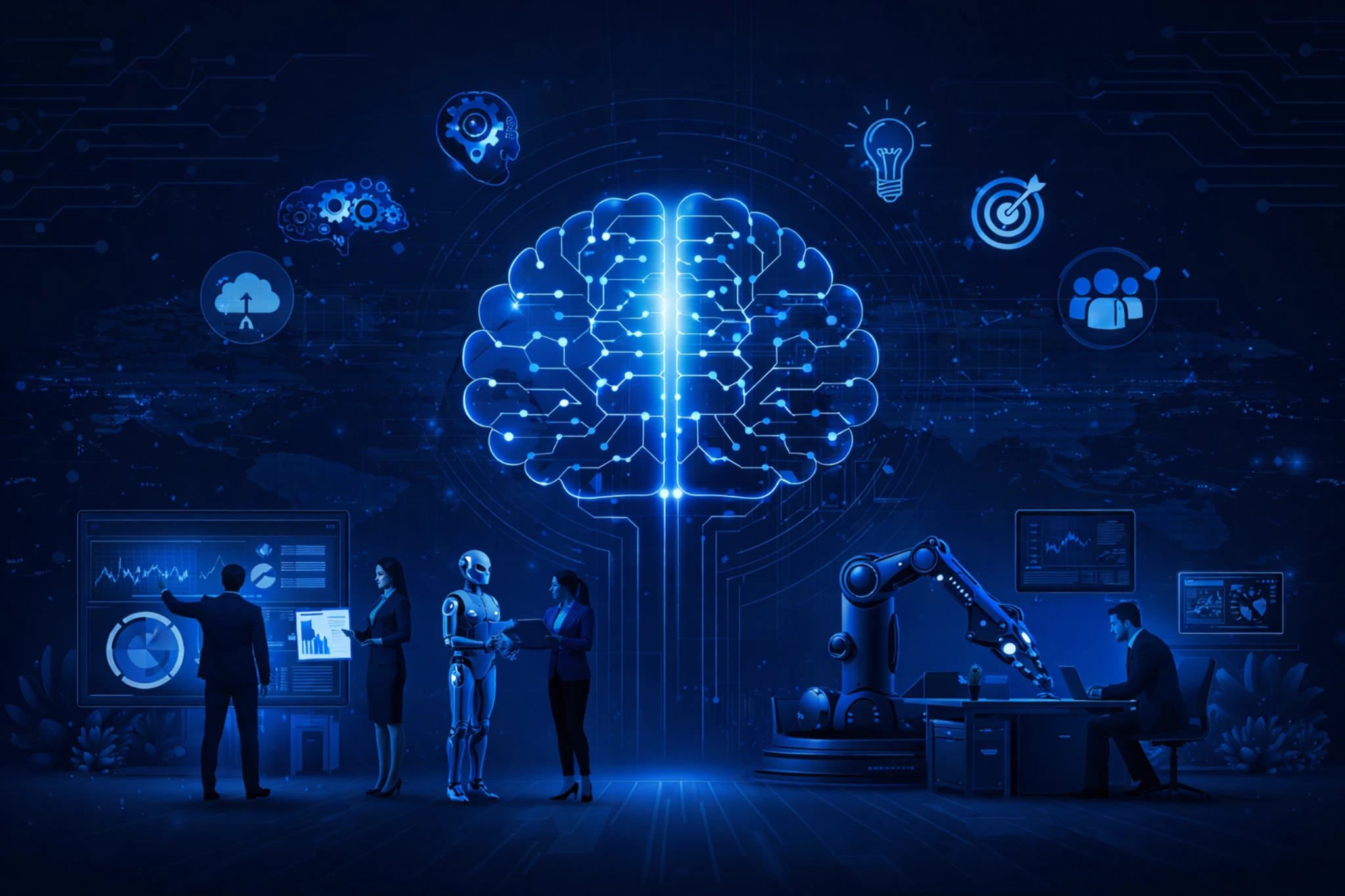
A Structural Shift in How Value Is Created
For
decades, the global economic model for talent followed a predictable
trajectory. Organisations scaled output by increasing headcount, optimised
costs by distributing work geographically, and built competitive advantage
through specialisation and scale. Countries, in turn, positioned themselves as
either innovation hubs or execution engines. This model proved effective in an
era defined by efficiency and cost arbitrage.
However,
this system was built on a foundational assumption, that productivity scales
linearly with human effort. And that assumption is now breaking.
Artificial
intelligence is fundamentally altering the relationship between labour and
output by enabling organisations to scale intelligence without proportionally
scaling the workforce. Early enterprise deployments already indicate 20-40%
productivity gains in knowledge-intensive functions when AI is effectively
integrated into workflows. At the same time, organisations report that up to 60-70%
of routine cognitive tasks can be partially automated or augmented.
This marks
a structural shift, not just in technology adoption, but in the unit economics
of knowledge work. Output is no longer constrained by human bandwidth alone; it
is increasingly driven by how effectively AI is augmenting human capabilities.
This
transition marks the emergence of the Scaled Intelligence Economy, where value
creation is determined by the quality, speed, and scalability of
decision-making, rather than the volume of labour deployed.
From Labour Arbitrage to Intelligence
Arbitrage
The first wave of globalisation was built on cost efficiency. Organisations
distributed work across geographies to reduce expenses, creating global supply
chains for both manufacturing and services, often achieving 30-50% cost savings.
The second wave introduced digital transformation, enabling speed,
automation, and connectivity. Today, however, we are entering a third phase - one
defined by intelligence arbitrage. This is not about where work is done, but
how intelligently it is executed.
In this model, the competitive advantage lies
not in where work is performed, but in how intelligently it is executed.
Artificial intelligence assumes responsibility for data-intensive and
repetitive tasks, while humans focus on judgment and strategy. Organisations
that effectively combine the two are seeing 2-5x improvements in decision speed
and measurable gains in output quality.
As a
result, businesses are shifting their optimisation lens from cost efficiency to
intelligence density, or the amount of actionable insight generated per unit of
effort.
Early Signals of a Systemic Transition
The
transition toward a Scaled Intelligence Economy is already visible across
industries.
Enterprises
are reallocating budgets, with estimates suggesting that 15-25% of operational
budgets in large organisations are being redirected toward AI and automation
initiatives. Hiring strategies are also evolving, with some firms slowing net
headcount growth while increasing investment in AI-enabled productivity tools.
Global
Capability Centres (GCCs) are moving up the value chain. In India alone, there
are now 1,500+ GCCs employing over 1.5 million professionals, with a growing
share focused on advanced analytics, AI, and product engineering.
At the same
time, productivity gains are increasingly driven by human-AI collaboration
rather than process optimisation alone. Organisations report 10-30% reductions
in decision cycle times and improved accuracy in data-driven functions.
Taken
together, these signals point to a clear shift: from scaling labour to scaling
intelligence.
India’s Emerging Role as a Global Intelligence
Engine
India is
uniquely positioned to lead this transition. The country produces over 1.5
million engineering graduates annually, creating one of the largest talent
pipelines globally. When augmented with AI tools, this workforce becomes a
powerful engine for scalable intelligence.
India’s
cost advantage further amplifies this effect. Organisations can achieve similar
or higher output levels at 30-60% lower operating costs, while leveraging AI to
enhance productivity.
Additionally,
India’s established GCC ecosystem provides a strong foundation for AI
integration. Many multinational corporations are now using their India-based
centres not just for execution, but for core functions such as AI model
development, data engineering, and decision analytics.
This
positions India not just as a talent supplier, but as a global hub for
intelligence generation and deployment.
Redefining Work: From Task Execution to
Intelligence Orchestration
The Scaled
Intelligence Economy is fundamentally changing how work is structured. Research
suggests that up to 50% of current work activities could be automated or
augmented using existing technologies, particularly in knowledge-based roles.
As a
result, professionals are shifting from task execution to intelligence
orchestration.
Financial
analysts, for example, can reduce model-building time by 60-70% using AI tools,
allowing them to focus on interpretation and strategy. Marketing teams are
leveraging AI to increase campaign efficiency and personalization at scale,
often achieving 20–30% higher engagement rates.
This shift
is creating new role categories focused on managing AI systems, interpreting
outputs, and driving decisions, highlighting the growing importance of human-AI
collaboration.
The Evolution of Global Capability Centers
Global
Capability Centres are undergoing a significant transformation. Historically
focused on cost efficiency, they are now becoming strategic hubs for innovation
and intelligence.
In India,
GCCs are increasingly handling high-value functions, with estimates indicating
that over 40% of new GCC investments are directed toward advanced capabilities
such as AI, analytics, and digital engineering.
This
evolution reflects a broader shift in enterprise strategy. Organisations are
moving from centralised models to distributed intelligence systems, where
decision-making is enabled across multiple locations.
As a
result, GCCs are no longer support units - they are becoming core drivers of
enterprise value.
Rewriting the Productivity Equation
The impact
of AI on productivity is both measurable and transformative. Studies suggest
that AI-enabled workflows can improve individual productivity by 20-50%,
depending on the function and level of integration.
This leads
to a new productivity framework:
Productivity
= Human Capability × AI Amplification
Unlike
traditional incremental productivity improvements, AI-driven gains are
exponential. Organisations can achieve higher output with fewer resources,
reduce time-to-decision, and improve overall efficiency.
Importantly,
this also changes how productivity is measured. Metrics such as output per
employee are being supplemented or replaced by indicators like decision
quality, speed to insight, and innovation output.
Emerging Risks and Strategic Constraints
Despite its
potential, the Scaled Intelligence Economy introduces several risks.
Talent
polarization is a key concern. As AI adoption increases, demand for high-skill,
AI-enabled roles is expected to grow significantly, while routine roles may
decline. Some estimates suggest that 20-30% of current roles could be
significantly transformed or displaced over the next decade.
Trust and
governance are also critical challenges. As AI systems influence
decision-making, organizations must address issues related to bias,
transparency, and accountability.
Finally,
organizational inertia remains a barrier. Surveys indicate that over 60% of
enterprises struggle to scale AI beyond pilot stages, highlighting the need for
structural and cultural transformation.
Industry-Level Implications
The Scaled
Intelligence Economy is reshaping industries at a fundamental level.
In
healthcare, AI-assisted diagnostics can improve accuracy rate by 10-20% while
reducing costs. In financial services, AI-driven fraud detection systems can
reduce losses by up to 50%. Retail organisations leveraging AI personalisation
are seeing 15-30% increases in conversion rates.
Across
sectors, the pattern is consistent: organizations that effectively combine AI
with human expertise outperform those that rely on either alone.
From Workforce Planning to Intelligence
Strategy
Organizations
must now shift from workforce planning to intelligence strategy.
This
involves rethinking how value is created, moving from headcount-based models to
intelligence-driven models. Instead of asking how many people are needed,
organizations must ask how much intelligence can be generated and applied.
This
requires redesigning roles, integrating AI into workflows, and developing new
performance metrics that reflect the realities of the Scaled Intelligence
Economy.
A Global Inflection Point
The rise of
the Scaled Intelligence Economy represents a global inflection point. It is
reshaping competitive advantage, talent dynamics, and investment priorities.
Countries
and organisations that can effectively harness this model stand to gain
significant advantages. India’s position in this transformation is particularly
strong, given its scale, talent base, and operational maturity.
For global
enterprises, the imperative is clear: move beyond experimentation and embed AI
into core business functions.
Unlocking the Full Opportunity
The
convergence of AI and human capital is already reshaping how organizations
operate and compete. Early adopters are seeing measurable gains in
productivity, efficiency, and innovation, while others risk falling behind.
This blog
provides a directional perspective on a rapidly evolving landscape. However,
the full implications of the Scaled Intelligence Economy require deeper
analysis.
In our
comprehensive whitepaper, we explore:
- Market
sizing and economic impact projections
- Industry-specific
transformation models
- GCC
evolution frameworks
- AI
adoption maturity benchmarks
- Strategic
implementation playbooks
For leaders
building long-term competitive advantage, understanding this shift is no longer
optional; it is critical.
>>Download
the full whitepaper to explore how AI and human capital are converging to
create the Scaled Intelligence Economy.